已关闭
已关闭
- 顶部Banner位
 固定模块
固定模块

 收藏
收藏 易享客服
易享客服
General Information
| Expression System: | HEK293 Cells |
| Preparation: | Recombinant human CD33 (AAH28152.1, Met1-His259) are conjugated with PE under optimum conditions, the unreacted PE was removed. |
| Labeling Rate: | The PE to protein molar ratio is 0.1-1 |
| Formulation: | Aqueous solution containing 0.5% BSA and 0.03%Proclin 300 |
| Concentration: | 10 μl/Test, 0.1 mg/ml |
| Form & Shipping: | Liquid. Shipping at ambient temperature. |
| Storage: | This reagent is stable for 6 months from date of receipt when stored at 2℃ - 8℃. Protected from prolonged exposure to light. Do not freeze ! |
| Usage: | The 5×10E5 cells are suspended in 50 μL washing buffer (1 X PBS + 1% BSA), add 10 μL CD33-PE, incubate for 45 min at 4℃ from light, then wash 2 times with wash buffer. Analyze by flow cytometry immediately. |
荧光标记的靶点蛋白
荧光标记的靶点蛋白,可直接用于CAR分析,避免因二抗交叉反应而引起的非特异性背景,并使检测更加高效。义翘神州已开发了多种荧光标记的靶点蛋白,涵盖当前CAR-T研究相关热门靶点,具有蛋白活性高,均一性好、批间一致性高等特点。同时,依托于先进蛋白表达平台,我们也可以提供“一站式”荧光标记蛋白的定制服务。
血液肿瘤热门靶点蛋白流式检测
使用FITC标记BCMA蛋白检测Anti-BCMA-CAR表达阳性率 (货号:10620-H03H-F)

图1:转染293细胞与FITC荧光标记的BCMA蛋白共孵育后,流式检测,未转染的293细胞作对照,CAR阳性细胞占比59.6%。
使用PE标记CD22蛋白检测Anti-CD22-CAR表达阳性率 (货号:11958-H08H-P)
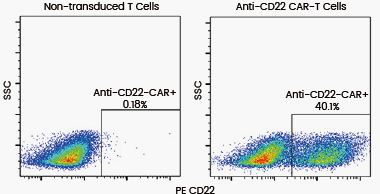
图2:转染T细胞后与PE荧光标记的CD22蛋白共孵育后,流式检测,未转染的T细胞作对照,CAR阳性细胞占比40.1%。
使用FITC标记CD33蛋白检测Anti-CD33-CAR表达阳性率 (货号:12238-HCCH-F)
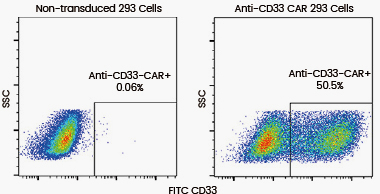
图3:转染293细胞与FITC荧光标记的C33蛋白共孵育后,流式检测,未转染的293细胞作对照,CAR阳性细胞占比50.5%。
使用FITC标记CD38蛋白检测Anti-CD38-CAR表达阳性率 (货号:10818-H08H-F)

图4:转染293细胞与FITC荧光标记的CD38蛋白共孵育后,流式检测,未转染的293细胞作对照,CAR阳性细胞占比49.1%。
Human CD33 / Siglec-3 Protein (PE conjugated): 别称
Siglec-3/CD33 背景信息