已关闭
已关闭
- 顶部Banner位
 固定模块
固定模块

 收藏
收藏 易享客服
易享客服
【试用装免费领】
活动日期:2026.4.20-2026.5.31
请提供:公司名称+手机号+产品名称+用量。
审核通过后安排寄送,限量赠送,先到先得。
Species
Human
Protein Construction
EGF (Asn971-Arg1023), Accession # P01133
Tag
No tag
Expression System
E. coli
Purity
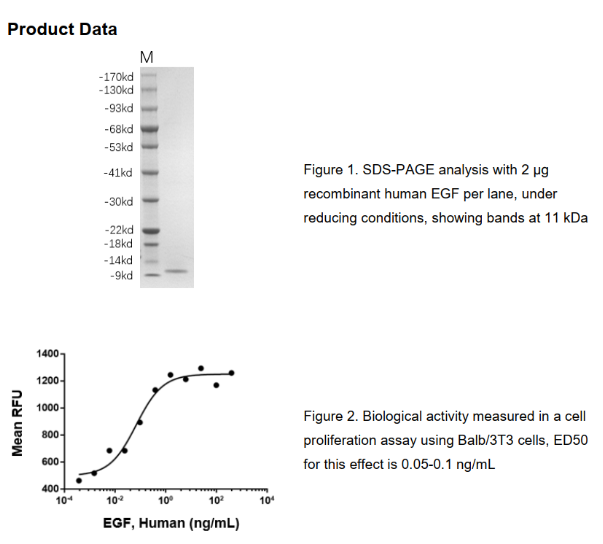
> 95% as determined by SDS-PAGE
Predicted Molecular Mass
6 kDa
SDS-PAGE
11 kDa, under reducing conditions
Endotoxin
<0.1 EU/μg of the protein by the LAL method.
Biological Activity
Measured in a cell proliferation assay using Balb/3T3 mouse embryonic fibroblast cells. The ED50 for this effect is 0.05-0.1 ng/mL.
Formulation
Lyophilized from a 0.22μm filtered solution in PBS
Reconstitution
It is recommended that this vial be briefly centrifuged prior to opening to bring the contents to the bottom. Reconstitute the lyophilized powder at 100 μg/mL in sterile deionized water
Storage&Stability
Use a manual defrost freezer and avoid repeated freeze-thaw cycles.
12 months from date of receipt, at lower than -70 °C as supplied.
1 month, 2 to 8 °C under sterile conditions after reconstitution.
3 months, -20 °C under sterile conditions after reconstitution.
Usage
Research use only
Background
Epidermal Growth Factor (EGF) is a potent growth factor that stimulates the proliferation of various epidermal and epithelial cells. Additionally, EGF has been shown to inhibit gastric secretion, and to be involved in wound healing. EGF signals through the EGF receptor (EGFR) also known as erbB1, is a class I tyrosine kinase receptor. This receptor also binds with TGF-α and VGF (vaccinia virus growth factor). EGF-receptor binding results in cellular proliferation, differentiation, and survival. EGF is a low-molecular-weight polypeptide first purified from the mouse submandibular gland, but since then found in many human tissues including submandibular gland, parotid gland. Salivary EGF, which seems also regulated by dietary inorganic iodine, also plays an important physiological role in the maintenance of oro esophageal and gastric tissue integrity. The biological effects of salivary EGF include healing of oral and gastroesophageal ulcers, inhibition of gastric acid secretion, stimulation of DNA synthesis as well as mucosal protection from intraluminal injurious factors such as gastric acid, bile acids, pepsin, and trypsin and to physical, chemical and bacterial agents.
 产品说明书-EGF.pdf